A Story of Struggle, Power, and Compromise in Pakistani Politics
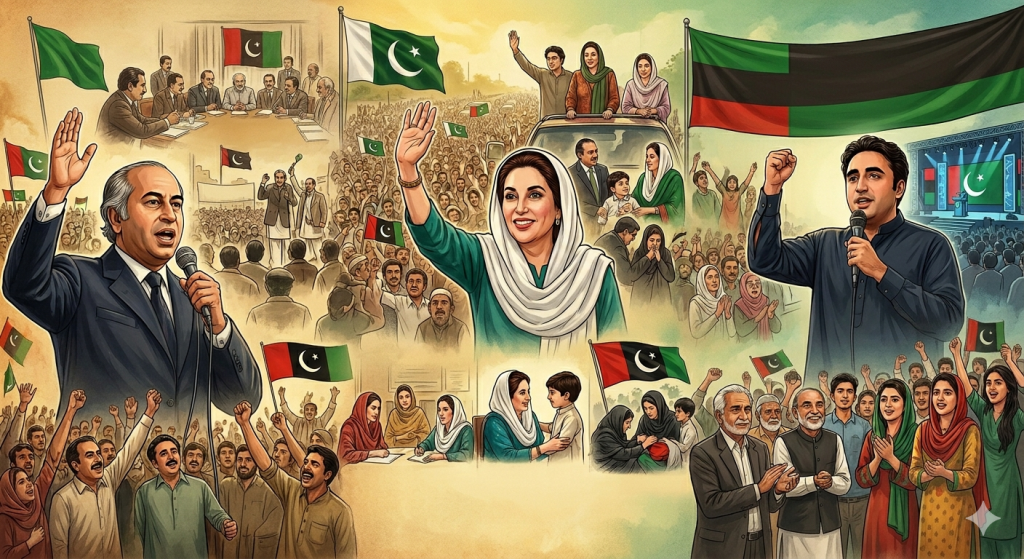
The Pakistan People’s Party (PPP) has shaped Pakistan’s political landscape like few others. Founded in 1967 by Zulfikar Ali Bhutto, the party rose on the slogan of “Roti, Kapra aur Makaan” (bread, clothing, and shelter). It promised social justice and stood against military rule for decades.
From its dramatic birth to surviving dictatorships, two assassinations, and long rule in Sindh, the PPP’s journey reflects the highs and lows of civilian politics in Pakistan. As an analyst, I see a party that delivered landmark reforms yet often compromised with the establishment to stay relevant.
Here is the complete, fact-based story — with positive achievements, criticisms, and hard truths about military interference in politics.
Formation of PPP and Zulfikar Ali Bhutto’s Early Struggle (1967)
Zulfikar Ali Bhutto, a young barrister from a influential Sindhi family and son of Sir Shah Nawaz Bhutto,, served as Foreign Minister under Ayub Khan. Disillusioned after the 1965 war and the Tashkent Agreement, he resigned in 1966.
On 30 November 1967, Bhutto founded the Pakistan People’s Party in Lahore. The founding convention brought together left-wing leaders, socialists, and progressives. The party’s creed — “Islam is our faith, democracy is our policy, socialism is our economy, all power to the people” — resonated with the poor, workers, and students.
Bhutto toured the country tirelessly, addressing massive rallies. He positioned himself as a champion of the downtrodden against Ayub’s dictatorship. His charisma and socialist rhetoric built a strong base in Punjab and Sindh.
Positive impact: PPP mobilized masses and introduced populist politics in Pakistan.
Criticism: Some historians note Bhutto’s style was personality-driven, laying the foundation for dynastic politics that later defined the party.
1970 Elections, Rise to Power, and Bhutto’s Tenure (1971–1977)
The 1970 general elections, Pakistan’s first direct polls changed everything. Sheikh Mujibur Rahman’s Awami League swept East Pakistan with 167 seats. Bhutto’s PPP won 81 seats in West Pakistan, dominating Punjab and Sindh.
Political deadlock led to the 1971 crisis and the tragic separation of Bangladesh. Bhutto became President and later Prime Minister of the new Pakistan.
Key achievements:
- Drafted and passed the 1973 Constitution — Pakistan’s first consensus document restoring parliamentary democracy. It remains the cornerstone of the system today.
- Launched Pakistan’s nuclear program, earning him the title “Father of the Nuclear Bomb.”
- Gave land to small farmers across the country at mass scale to empower them.
- Agreements with Gulf countries to provide Pakistani labour.
- Established Steel Mill in Karachi, which was the Asia’s largest at that time.
- Introduced labor reforms, land reforms, and social welfare measures.
- Hosted the 1974 Islamic Summit in Lahore, boosting Pakistan’s global Muslim leadership.
- The 1974 amendment to declare Ahmadi as non-muslims.
Negative points and controversies:
- Nationalization hurt the economy and private sector.
- Military operation in Balochistan caused heavy casualties and human rights concerns.
- Growing authoritarian tendencies and suppression of opposition.
Bhutto’s government delivered visible progress for the poor but faced accusations of mismanagement and heavy-handedness.
Rift with Zia-ul-Haq, Jail Time, and Execution (1977–1979)
After disputed 1977 elections and opposition protests, General Zia-ul-Haq imposed martial law on 5 July 1977. Bhutto was arrested on murder charges related to a political rival after few days.
Bhutto spent months in jail. He refused to compromise. Zia’s regime tried him in a controversial case widely called a “judicial murder.”
On 4 April 1979, Zulfikar Ali Bhutto was hanged in Rawalpindi Central Jail despite international appeals for clemency. The Supreme Court later acknowledged in 2011–2024 reviews that he did not receive a fair trial.
This execution shocked the nation and turned Bhutto into a martyr. It deepened public distrust of military interference in politics.
Role of Nusrat Bhutto and Benazir Bhutto’s Struggle (1979–1988)
After Bhutto’s death, his wife Begum Nusrat Bhutto led the party with courage. She faced house arrest, harassment, and health issues but kept the flame alive.
Their daughter Benazir Bhutto, educated at Harvard and Oxford, emerged as the new face. She endured imprisonment, exile, and constant threats.
Benazir returned in 1986 to massive welcomes. Her struggle against Zia’s dictatorship symbolized hope for democracy. Zia’s death in a 1988 plane crash paved the way for elections.
Benazir Bhutto’s Two Tenures as Prime Minister (1988–1990 and 1993–1996)
First tenure (1988–1990): Benazir became the first woman Prime Minister of a Muslim-majority country. She restored trade unions, released political prisoners, and promoted freedom of speech.
Positive: Advanced women’s rights, education initiatives, and diplomatic outreach.
Negative: Faced corruption allegations, coalition instability, and dismissal by President Ghulam Ishaq Khan in 1990 on charges of misconduct.
Second tenure (1993–1996): She focused on foreign investment, social programs, and privatizing some industries. Relations with the military remained tense.
Achievements: Attracted some investment, continued welfare focus and started missile program which is critical in country’s defence.
Criticisms: Persistent corruption scandals involving her husband Asif Ali Zardari, economic challenges, and law-and-order issues led to dismissal again in 1996.
Benazir survived two dismissals and long exile. Her legacy is that of a brave democrat who fought military rule and inspired women across the Muslim world. She kept the PPP united through the darkest times.
Even she was in exile. PPP was the old national level party which has roots at ground from Karachi to Khyber. There was a popular slogan ‘Charon subon ki zanjeer, Benazir, Benazir’
PPP During Musharraf Era, Charter of Democracy, and Benazir’s Assassination (1999–2007)
Benazir Bhutto first supported General Pervez Musharraf’s 1999 coup against Nawaz Sharif government and then later critized it. It forced Benazir into exile again. PPP faced repression but stayed active in opposition.
In 2006, same Benazir and Nawaz Sharif signed the Charter of Democracy in London and formed an opposition alliance known as ‘All Parties Democratic Movement (APDM)’. This historic document committed both parties to end military rule, respect mandates, and strengthen institutions, a rare moment of civilian unity.
Benazir returned to Pakistan on 18 October 2007 for elections. On 27 December 2007, she was assassinated in Liaqat Bagh, Rawalpindi while campaigning. The attack shocked the world and remains controversial, with many suspecting involvement of extremists and elements within the establishment.
Her death created massive sympathy. It also highlighted the dangers of challenging entrenched powers.
Asif Ali Zardari’s Leadership and PPP Tenure (2008–2013)
Asif Ali Zardari, Benazir’s husband, became co-chairperson with son Bilawal. PPP won the 2008 elections and formed a coalition government, the first government to complete a full five-year term since 1947.
Major achievements:
- Passed the 18th Amendment (2010), restoring the 1973 Constitution, abolishing the concurrent list, and devolving powers to provinces — a landmark for federalism.
- Restored powers to Prime Minister after removing 58-2/B from constitution which gave powers to President to dissolve assemblies.
- 7th NFC Award gave provinces a bigger share of resources.
- Launched Benazir Income Support Programme (BISP), helping millions of poor families (especially women).
- Successful operation in Swat against Tehreek-e-Taliban Pakistan (TTP).
- Peaceful transition of power in 2013.
Criticisms: Faced energy crisis, inflation, imposed governor rule on Punjab, terrorism (war on terror fallout), and serious corruption allegations. Governance was often called weak, with Zardari’s presidential style drawing flak.
The government survived through reconciliation politics and compromises with other parties such as MQM, PMLQ, ANP, JUI-F and at times, the establishment.
PPP’s Role During PML-N Tenure and Panama Scandal (2013–2018)
After a massive defeat in 2013 elections, particularly wiped out in Punjab and KPK. PPP new role is to sit on opposition benches.
In opposition, PPP adopted a “friendly opposition” approach toward PML-N at start, specially during PTI famous 126 days dharna at D-Chowk but during the Panama Papers case (2016–2017), which led to Nawaz Sharif’s disqualification, PPP was allegedly supported the supreme court melafied verdict and called for accountability.
Asif Ali Zardari was very active at backdoor diplomacy and throw the PMLN government in Balochistan with the help of establishment.
Bilawal and party leaders positioned it as a win for the rule of law. Some analysts saw it as pragmatic politics, avoiding direct confrontation while benefiting from PML-N’s troubles. This period showed PPP’s preference for reconciliation over all-out opposition.
Bilawal Bhutto Zardari’s Leadership: The New Generation (2010s–2026)
Bilawal Bhutto Zardari officially entered politics as PPP Chairman. He served as Foreign Minister (2022–2023) in the PDM coalition, focusing on diplomacy.
Under Bilawal, PPP has emphasized youth engagement, climate issues, and Sindh’s rights.
In the 2024 elections, the party secured seats and joined coalitions without taking many cabinet positions, showing a strategy of influence without full responsibility.
Bilawal continues the family legacy with modern communication while defending the 18th Amendment and provincial autonomy.
ALSO READ
PPP’s Long Rule in Sindh: What Has Been Delivered?
Since 2008, PPP has ruled Sindh uninterrupted. Bilawal and the party often highlight this stability but their critics has so many valid points to say on their governance.
Positive developments:
- Investments in healthcare (e.g., expansions in NICVD, SIUT models), education, and infrastructure.
- Benazir Income Support Programme scaled up.
- Some progress in revenue collection and flood rehabilitation.
- Defended provincial autonomy under the 18th Amendment.
Criticisms and ground realities:
- Despite trillions spent on development, Sindh lags in key indicators, clean drinking water, quality education, local government functionality, and urban infrastructure (especially Karachi & Hydrabad).
- Persistent issues of corruption, nepotism, and weak service delivery.
- Opposition and analysts argue that long rule without strong local governments has led to centralization and inefficiency.
PPP frames Sindh’s challenges as results of federal neglect or conspiracies against the province. Critics say accountability and better governance are needed after nearly two decades in power and during all this, their world famous slogan “Roti, Kapra or Makaan” lost somewhere.
PPP’s Struggle Against Military Rules and Compromises with the Establishment
PPP has a proud history of resisting military dictators — from Bhutto’s defiance of Zia to Benazir’s long fight against Zia and Musharraf. The party suffered hugely: executions, exiles, assassinations, and repression.
Yet, analysts note repeated compromises. From coalition politics to “reconciliation” under Zardari, PPP often chose survival and power-sharing over confrontation. This pragmatism helped complete terms and pass reforms like the 18th Amendment.
However, it also drew criticism for softening anti-establishment stance at key moments. The military’s repeated interventions, coups, dismissals, and alleged rigging have damaged democracy.
True civilian supremacy requires all parties, including PPP, to consistently resist such interference rather than accommodate it for short-term gains.
Pakistan’s history shows that military involvement in politics breeds instability, weakens institutions, and fuels extremism. Strengthening the 1973 Constitution and ending “state within a state” remains unfinished business.
Lessons from PPP’s Long Journey
The PPP’s story is one of resilience. It gave Pakistan its constitution, nuclear deterrence, social welfare foundations, and devolution through the 18th Amendment. It survived military rule through the courage of the Bhutto family and loyal workers, who sacrifice their lives.
Yet challenges remain: dynastic leadership, governance issues in Sindh, corruption perceptions, and uneasy relations with the establishment. For the party to regain national strength, it must deliver visible development, empower local governments, and consistently champion civilian supremacy.
What do you think about PPP’s journey? Has the party lived up to Zulfikar Ali Bhutto’s original vision, or has compromise diluted its revolutionary spirit?
ALSO READ