

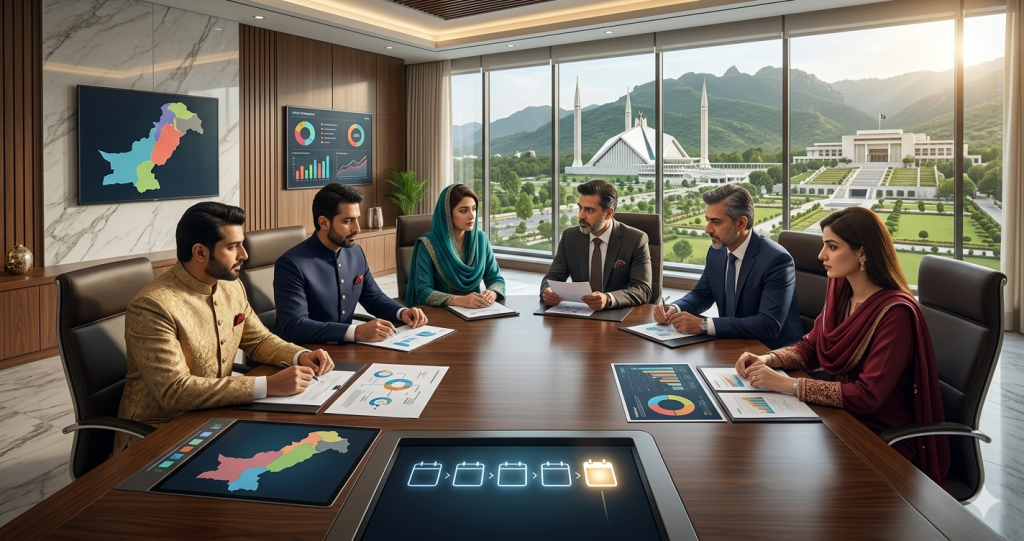
Pakistan’s politics is never simple. After every few years, the big questions emerges: Who will win the next election? Who will become the next Prime Minister of Pakistan?
The next general elections are expected by early 2029, though early polls remain possible. As of April 2026, the country is run by a coalition government led by Prime Minister Shehbaz Sharif of PML-N, supported by PPP and other smaller parties.
Imran Khan and PTI remain highly popular among the masses but face serious legal and political challenges.
No one can say for sure what will happen in 2028-29. Politics in Pakistan often depends on public mood, economic conditions, alliances, and many believe the preference of the powerful establishment.
Here are three realistic scenarios for the next Prime Ministership. These are based on current trends, past patterns, and political realities. Everything is open-ended — nothing is certain.
Scenario 1: Shehbaz Sharif Returns as Prime Minister
Shehbaz Sharif is currently serving as Prime Minister and is known as an experienced administrator. He has a reputation for completing development projects quickly, managing coalitions, and keeping things stable.
Why this can happen:
- PML-N still has strong roots in Punjab, especially among traders and older voters.
- If the economy improves even slightly (lower inflation, better IMF deals, or CPEC progress), PML-N can take credit.
- Shehbaz has shown he can work with PPP and other parties to form governments.
Challenges:
- Many young voters still strongly support Imran Khan and see PML-N as part of the “old system.”
- Nawaz Sharif’s health and long stays abroad raise questions about party leadership.
- Public frustration over price hikes and unemployment can hurt PML-N.
Question for readers: Can Shehbaz Sharif repeat his success as a “doer” and convince people that stability is better than change? Or will anti-incumbency become too strong?
PML-N would likely need strong support from the establishment and clever alliances to win enough seats.
Read More: Men vs Women Politicians – Who is Better in Politics?
Scenario 2: Maryam Nawaz Conquer Islamabad After Punjab
Maryam Nawaz is currently Chief Minister of Punjab and the most visible new face in PML-N. She is energetic, active on social media, and focuses heavily on health, education, infrastructure, cities uplifting and women’s issues.
Why this scenario is possible:
- Many PML-N workers see her as the future of the party.
- If PML-N performs well in Punjab, she could be the natural choice for PM.
- A female Prime Minister would be historic and could attract international attention.
Big challenges:
- Traditional voters and some conservative sections may resist the idea of a woman leading the country.
- Military establishment could not be very happy because of her bold stance in the past.
- She still carries the baggage of family politics and past controversies.
- Winning enough seats outside Punjab will be difficult without strong alliances.
Interesting point: Nawaz Sharif has always preferred development-focused politics. If PML-N highlights infrastructure, roads, and energy projects (areas where they have delivered in the past), Maryam could ride that wave.
Would Pakistan accept Maryam Nawaz as Prime Minister? Would her style appeal more to women and young voters than traditional leaders?
Scenario 3: Bilawal Bhutto Zardari Emerges as a Surprise or Consensus Prime Minister
Bilawal Bhutto Zardari is young, educated, and has improved his public speaking. He served as Foreign Minister in PDM tenure and is the chairman of PPP, which still controls Sindh since 2008.
How this can happen:
- If no single party gets a clear majority, PPP can play kingmaker again.
- Bilawal is seen as more acceptable to different groups compared to harder personalities.
- In a hung parliament, a grand coalition or consensus candidate often emerges.
The PTI Angle – The Most Interesting Twist:
Here is where things get really interesting. Suppose elections produce mix results. PTI wins alot of seats but cannot form the government alone due to legal issues or seat shortages.
PPP under Bilawal could offer a deal: “Join us or support us to form a stable government.” Some analysts believe PPP might try to break PTI by offering ministries or protection to moderate PTI leaders. In return, they could create a new ruling alliance.
This would be classic Pakistani politics, alliances made in Islamabad that surprise everyone.
Challenges for Bilawal:
- PPP’s vote bank is mostly limited to Sindh and parts of interior Sindh.
- Long rule in Sindh has delivered some improvements in health (like NICVD) but critics point to poor education, water problems, curruption and weak local governance.
- Many voters still see PPP as a party of the past rather than the future.
Read More: If Politicians Want Trust from Voters, They Should Do These Things Right Now.
Military and Nawaz Sharif Preference:
The establishment (military leadership) has historically preferred ‘YES MAN’ types leaders who do not challenge their role directly.
At the other end, Nawaz Sharif wants strong development and has often clashed with the establishment in the past. Many believe the military prefers “predictable” and “manageable” civilian faces over populist ones.
They already tried all the major players of this chess game but now, their options are limited.
Would Bilawal be acceptable to all stakeholders? Could a PPP-PML-N or PPP-PTI type understanding be worked out behind closed doors? These are the million dollar questions at the moment.
The Imran Khan and PTI Factor – The Game Changer
No analysis is complete without PTI and Imran Khan at this point of time.
Even in 2026, Imran Khan remains extremely popular, especially among youth, urban middle class, and overseas Pakistanis. Surveys often show him as the most popular leader by a large section of people.
However, PTI faces major hurdles, court cases, leadership in jail or exile, and organizational challenges. If the party is allowed fair participation and Imran Khan’s symbol is restored, they could sweep many seats in current scenario but who knows how things will unfold in 2029. It’s a long way to go.
Key questions:
- Will PTI be fully restored or will independent candidates continue?
- Can PTI turn massive public support into seats without a strong organizational structure?
- If PTI wins big, will they be allowed to form the government, or will another coalition block them?
Many believe the real decider will not only be votes but also post-election negotiations and the establishment’s comfort level.
ALSO READ
What Will Decide the Next Prime Minister?
Several factors will shape the outcome:
- Performance of the current government on economy and inflation
- Public anger or satisfaction with current ruling parties
- Role of social media and youth turnout on election day
- Behind-the-scenes lobbing of powerful institutions
Pakistan’s history shows that unexpected things happen. Governments that look strong today can weaken tomorrow. Leaders who seem finished can make comebacks.
Final Thoughts
So, who will be the next Prime Minister of Pakistan? Shehbaz Sharif, Maryam Nawaz, Bilawal Bhutto Zardari, or someone from the PTI camp or a powerless face that represents only establishment interests?
Will it be continuity with PML-N’s development focus? A historic shift with Maryam Nawaz? A compromise with Bilawal? Or will Imran Khan’s popularity force a completely new equation?
Everything is possible in Pakistani politics. The coming years will test whether our democracy can deliver what people truly want — jobs, justice, better governance, and real civilian supremacy.
What do you think? Who would you like to see as the next Prime Minister and why? Do you believe public vote alone will decide, or will other factors play a bigger role?
ALSO READ


